Loading... Please wait...
U.S Armor in Vietnam
Posted by Glen Broman on 20th Jul 2026
Book Review
U.S Armor in Vietnam
Published by AK Interactive
Reviewed by Glen Broman
https://shop.lastcavalry.com/ak-interactive-u-s-armor-in-vietnam/
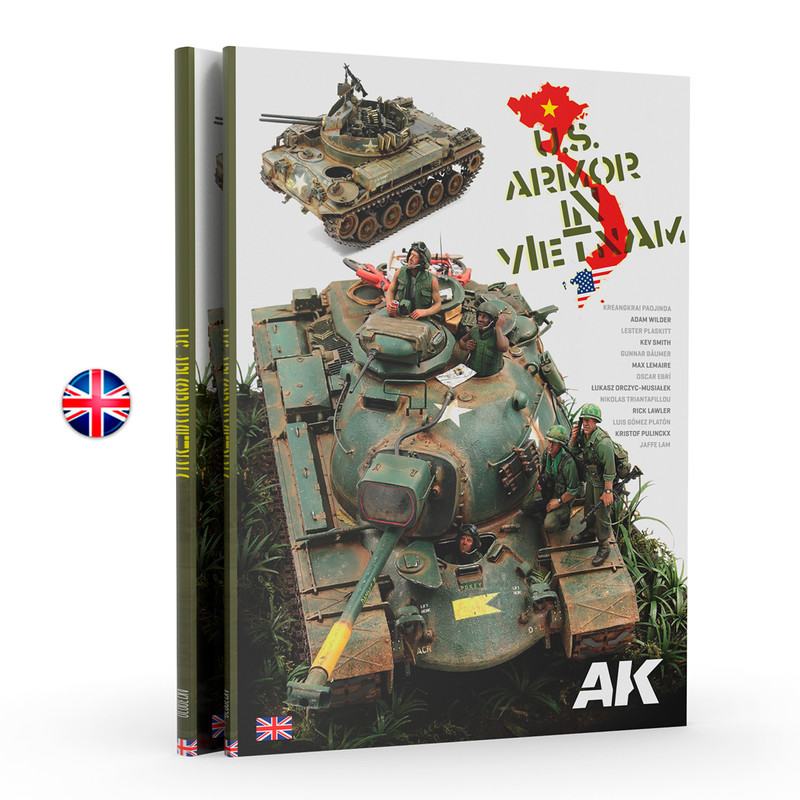
It’s time for another one of my dives into the world of books on Armor subjects. I saw this on the New Releases page on the Last Cavalry web site and stopped by the Last Cavalry World Headquarters to pick it up. This is a 189 page full color book with 13 subjects covered by some really top notch modellers, such as Lester Plaskitt, Adam Wilder, Rick Lawler, Kristof Pulinckz and Kreangkrai Paojinda, just to name a few. The photography and production values are absolutely top notch. The subject matter is not too shabby as well, I mean, it’s all about tanks and other armored vehicles, so what’s not to love?
The book follows the standard format with an intro and chapters on each subject, but it does have some neat additions. There is an eight page introduction that provides context for the vehicle and the subjects use in Viet Nam. Serious historians and Subject Matter experts will find little to quibble with. This section also has some yummy color and black and white photos that are good references. Following that is one of the neat additions I mentioned earlier – a two page spread with box art photos of model kits of Vietnam War subjects, which includes subjects not covered in the book, so you get a nice cross section of air, ground and naval subjects. There is an additional six page gallery of dioramas that cover a variety of subjects, to include two French converted landing craft. There is also a short section on the terrain of Vietnam which will provide insight to those building dioramas.
Now we hit the meat and potatoes, the build section. This is a visual feast of modelling tactics, techniques and procedures. In my opinion, this is where the value of the book lies. As a beginning or intermediate modeler, you can pick a subject of interest to you and follow the step by step process of some truly excellent modelers to help expand your experience and skill. If you are more advanced, or want to try something new and interesting, pick or choose from the techniques to do some experimentation to add you your modelling repertoire. There are some very good explanations tied to numbered step by step photographs that are very helpful. There are a few that will leave you scratching your head trying to discern the results, but they are few and far between and to be fair, they are likely the result of trying to reproduce a very subtle effect in a photograph. No doubt the result would be much more visible in person. I think of these techniques as recipes, when I cook, I add a little here and there, or make changes to suit my taste. It’s the same with this book, if you like the effect, you can run with it, if you think it is over or underdone, you can use the basic techniques to suit your own taste. There is generally very little on the build sequence, just a few high points, or things to watch out for with the majority focused on painting, weathering and the basing.
The chapters cover the Otter, M113A1 and M577A1, the M42, Several different flavors of truck, the M110, the Ontos, The V-100, The M551, my personal favorite, the M88, M48 and a fascinating chapter on the Gecko kit of the PACV. Another addition is several different figure vignettes and a wedgie. The wedgie is described as an M113, but is actually an M132 flamethrower. Although they are technically not armor subjects, it’s nice to see the figure modellers get a little love, beyond the crew figures on the vehicles. There are some nice groundwork techniques up in here to add some spice to your finished product.
There is one thing you will need to decide for yourself. What is the shade of Olive Drab that you want to run with? The 1960’s shade of OD was darker than the WWII shade and having spent a good portion of my young adult life living in large armored things painted OD, I have my own opinion. I had difficulty with the choices some of the modelers made. The M48A3, for example, it looks far too green to my eye, the builder stated he used reference photos, but I would caution folks that the Marines used a color called Marine Corps Green, a description that makes up for in accuracy what it lacks in originality. That color is much greener and is nearly identical to the color of the model. Some remained in Army OD, some were repainted by the Marines. The bottom line is that you get to make your own call based on what choices you want to make. Again, the value of the book is seeing what other modelers did and evaluating that information to make your own decisions.
The final few pages are some adverts. One being from Gecko Models that shows a 1/35th scale Swift Boat. Be still my beating heart. Overall, I recommend this book, there is a lot to play with and it is a visual feast. I purchased my copy from Last Cavalry (www.lastcavalry.com)